Problems Artificial Intelligence Creates For High-Context Roles Like Project Management

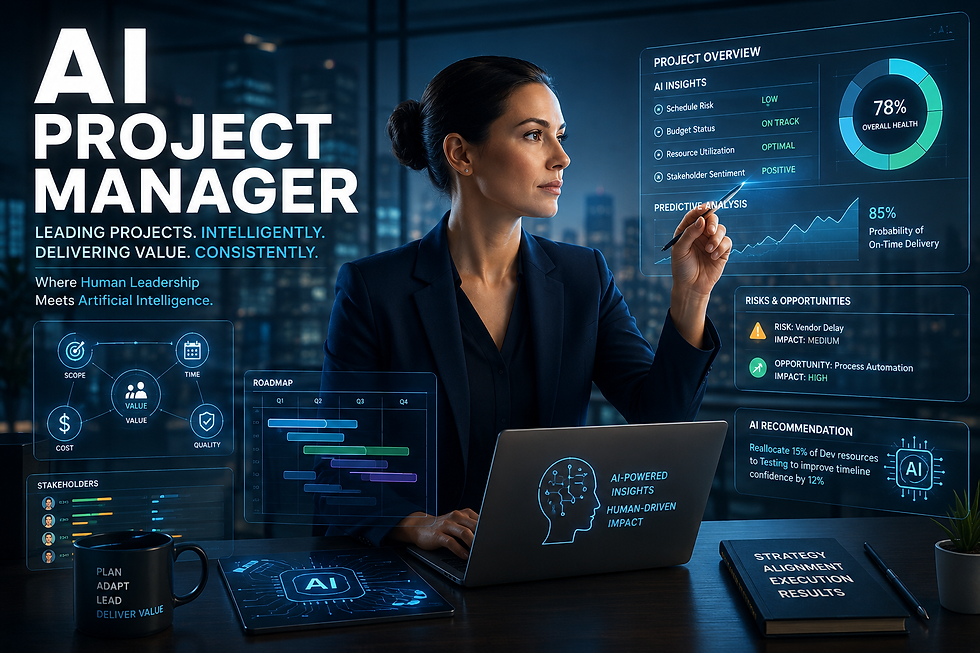
In the last 2 years, we have seen a plethora of companies, coaches and professionals pushing the use of AI into high-context driven professions such as Project Management (PM). The interesting thing to note is a majority of these pushes have not resulted in positive ROI. In fact AI has been effectively damaging such professions.
Both in the short-term and in the long-term.
Now, you may wondering why is a project manager of nearly 20 years is writing on artificial intelligence when he's not a data scientist and only recently started managing data strategy projects.
Similar to my previous article on tackling the topic of "Everyone is a Project Manager," we are callously throwing out & adopting ideas that can have long lasting implications. We need to take a moment and really evaluate the ramifications of throwing the idea AI as an efficiency tool.
Here is one such idea:
AI can take the activities of a project support role and allow project managers to focus on more strategic & team elements.
You see, not only is this statement dangerous but it is objectively false (at least for now). The underlying idea is that AI taking a full role and opening up more time to focus on other elements, yet such recommendations can lead to horrendous long-term outcomes.
This article is going to attempt to shed some light on the realities of Project Management AI use. It will also illustrate some of intense skepticism on its continued usage without some long-term planning. (Perhaps even act as a cautionary tale)
But,
In order for us to truly talk about AI and its impact on the project management world, we need to understand few important things first.
Quick Primer on AI
Below is not meant to a full course on the subject but enough information to follow the arguments on the impacts AI will have on the role of the project manager (inside and outside of the project).
Let us begin with an overview of the main types of AI you have likely encountered or heard about.
AI Has Four Main Types You Should Be Aware Of
Artificial intelligence at its basic definition is the act of trying to emulate human decision-making & thinking through the pattern interpretation of large amounts of data. The intent is to generate predictions, insights, and content across multiple schools of thought and contexts.
The behavior of the AI model, and its output is based on logic and rules built into the model by another person or group of individuals.
There are four main types to consider:
Note, there are subsets to these four main types, but for the sake of this article we will not delve into them.
Look-Up/Retrieval - This type of AI is looking at existing content trying to find the exact or near matches, similar to the concept of Excel VLook up function. It behaves like a search engine leveraging vector, database and query searches.
Classification- This second type of AI is grouping or categorizing existing data, assigning labels, tags, sorting based on a prompt or logic employed.
Generative - This third group of AI is creating new content based on probability and or recognized patterns.
Agentic - This final version of AI combines the concepts of generative AI and adds a level of autonomy or independence behind it. It builds reasoning from memory, feedback loops, and external tools (APIs, web browsers, databases) to execute its own rule based decision-making.
Now that we understand the basics of AI, we need to understand one more set of ideas. Which is AI is driven by data. Therefore we need to understand the work that must be in place for AI to be successful in the long run.
The Foundation To Get AI Right
For the sake of simplicity there are four key elements to get right to make AI both effective and long lasting.
Data strategy
Data governance
Data architecture
Data driven culture
Data strategy - Before we can even build a model we need to determine what our business objective is and what data will support that outcome. This is building a roadmap for acquiring, storing and managing information. This includes answering questions such as:
What sort of data do we want? (structured, unstructured)
Where will the data come from and how will we acquire it? (internal, external)
How will we map data across different systems?
Will there be a historical data or will it be just ongoing? (incremental)
How we will define quality data?
What models will we use?
The key is like any initiative there needs to be a set of principles or guardrails before you can begin a detailed plan.
Data governance - In addition to defining the strategy for data, we need to be build an accountability & decision-making rules for that data. Typical considerations include:
Who owns the data?
Who will maintain it or ensure its quality?
How will data be cleansed or transformed?
How is data validated?
How is data monitored and recovered?
Who can access the data? (read v write)
How is information protected so it meets the compliance and regulatory requirements?
What are the policies and processes to gaining access to the data?
If we do not have this, data will cease to be useful and produce poor quality decisions and outputs.
Data architecture - We move from a strategic view of data movement to the direct technical aspects. This element defines how data is collected, integrated, stored, transformed, and delivered. Key things to consider include:
What systems does the data reside in?
How will data be consumed or ingested? (batch, API, manual upload),
Where will the data be stored? (Data warehouse, Data lake, Data zone)
How will data from multiple systems be integrated?
The key point is that the technology must meet the demands of the data strategy.
Data culture - In order to leverage AI correctly, you need to embedded data into every process, policy, and social norm of the organization. This means that everyone treats data, its integrity, its application and maintenance of key importance to the entire organization. Elements to consider include:
Decisions are supported by data and logic.
Data entry and validation at every step of business processes.
Performance management emphasizing data collaboration and maintenance.
Data entry and maintenance activities are prioritized and team members are given ample time.
Data literacy and tool training is provided each member of the organization.
If value of data is not embedded throughout the organization and only sits at leadership level the entire use of AI will fall apart.
Now, with the basics out of the way, lets dive straight into the first layer of problems that a high-context driven role like project management will encounter using AI.
Problems With AI in Project Management
Assuming we have the foundation of AI in place, we still face some rather difficult situations or elements that impact not only the effectiveness of AI but also its feasible application.
Ownership of the data - This is one of the largest problems in the modern world. In order to train a model and leverage AI you need data, but the data you need may not all come from sources in which you personally own or have been given permission to use with AI. Think about a few common scenarios:
Calendars or emails that are with people inside or outside of the organization.
Trade secrets, proprietary information, sensitive information (remember processes, performance figures, client names, intellectual property can be trade secrets which have a higher level of protections in place).
Transcripts to meetings with participants who may or may not consent to recording.
Industry reports that may not be public.
Operational performance of the organization (including customer service outages).
Other projects/programs or portfolios risks/issues and performance.
The key point is a project manager may not have the right to place this data into the AI model or will not have access to it in the first place.
Quality of output - Artificial intelligence has been known to be confidently wrong. An example includes some lawyers who were sanctioned for using AI to cite imaginary case law (LA Times - attorneys used ai cited fake legal decisions). We can take this same concept further and look at how many project professionals are given templates or prompts with little understanding or tailoring. This effectively requires the need to re-prompt or revise the existing output from an AI model.
In some cases this quality gap can eat up token costs and or result in the same activity taking longer than if it was done manually.
Timing of data - Here is the harsh reality to using AI, not all the data needed comes in at the same time, and there will be lags in data collection and usage. Think about how projects have different teams across the globe, or that some information is generated on a different cadence than just daily instances.
If we are leveraging AI to make timely decisions and some of the data is not going to be available until there is either manual intervention or refresh... we have a problem.
Disparate data - Not all data for a project comes from the same source or even in the same format. In fact, some data components for project evaluation will reside in or across departments, within operational details or under industry related information. No company is going to centralize all this information for two big points:
Security liability (ransomware and disaster recovery concerns).
Ownership and maintenance of the data becomes increasingly complex & costly.
The worst situation that can happen with disparate data is to have data that sits in systems that are incompatible with modern tools or processes.
Uncodified data - This is the biggest pain point for project management, and all high-context driven professions which want to use AI. If the data you act on is not in some digestible format for an AI model to leverage; the model will never be able to account for it. Note, that some of this type of data is related to politics, interpersonal dynamics that will never be placed into written or referenceable format (for obvious reasons including legal liability).
If your job requires you to act on information that is never published or tracked, then AI as a tool is not only limited but can be reckless to use.
Liability from the output - This is already starting to play out in the legal court systems. Applications like Workday used AI for screening candidates and the scoring system left some disparate impact which means it negatively impacted protected classes more than others. (SHRM - Workday AI Lawsuit).
AI cannot be a black box that spits out an output with no repercussions to both is validity and also the outcomes it creates. The impact this will have on project management is directly not known yet; but imagine if a recommendation or analysis was derived from an AI model or prompt? Who is at fault? The user of course, the project professional.
Now that we have analyzed the prevailing immediate problems in using AI in project management, we need to dive into one more concept before we can talk about the long-term impacts AI will have to the project management profession and its professionals.
That concept is Bloom's Taxonomy Higher-Order Thinking Skills.
Understanding Different Levels of Thinking
Bloom's Taxonomy is a model that illustrates how learning & application of learning evolves from basic understanding to sophisticated reasoning, judgment, and innovation. As professionals progress through its levels, they move from simply understanding to complex levels of critical thinking.
The taxonomy is organized as a hierarchy, with each level building on top of the one before it. The first three levels are generally considered lower-order thinking skills, while the final three levels are higher-order thinking.
Level 1: Remember - The lowest form of thinking, commonly known as rote memorization. Able to recite or retrieve existing information from memory.
Example: Recognizing the term Agile or stakeholder.
Level 2: Understand - Moving up into the next level of thinking we have the ability to describe or summarize facts, concepts or ideas.
Example: Creating meeting minutes or status update.
Level 3: Apply - In this third level of thinking, we begin to apply interpretation or solve problems using existing knowledge, facts, techniques and rules.
Example: Creating a project plan or roadmap.
Level 4: Analyze - Examining and breaking information down into parts by identifying motives or causes. Making inferences and find evidence to support generalizations.
Example: Identify risks or issues to a project.
Level 5 Evaluate - Within the penultimate stage of thinking we are presenting and defending opinions by making judgments about information, validity of ideas or quality of work based on a set of criteria
Example: Providing recommendations or tradeoffs to risks or issues.
Level 6: Create - In the highest level of thinking, we are compiling information in a different way by combining elements in a new pattern or proposing alternative solutions, through generating, planning or producing.
Example: Creating a project strategy or governance model.

(Some of you already know where this is going, but just hang tight)
Now that we have a fundamental underrating of AI, the problems AI has in applying to a high context field like project management and the 6 levels of Blooms Taxonomy of Higher-Order Thinking, let us finally deep dive into the long-term ramifications of AI.
Long-Term Dangers of AI Usage
We can break this down into two main categories
Everything outside the role of the project, such as thought leadership, social & economic behaviors, and interacting within project communities.
Everything within the role of a project professional including capabilities, skills & future development.
Let's start out with everything outside the role of project management.
External Impact
Thought leadership - Project professionals are becoming increasingly repetitive or 'lazy' in posting and creating content related to project management. From flimsy and superficial 1-pagers, to rehashed and incorrect methodology reviews. The prevalent use of AI has not only showcased the Dunning-Krueger effect in full force, but also is proliferating the wrong information at lighting speed.
This not only impacts the project profession from a perception perspective but it is also instills the wrong principles or fundamentals for early career project managers. This in turn, erodes both the quality of ideas circulating the community and also regresses the entire profession to the superficial and meaningless discussions.
Social & economical - I do not want to dwell too much on this point but AI has the potential to impact our resource consumption from a water and land perspective, as well as drive up utility costs for premium or low grade electricity. It also has the ability to move all aspects of life to ledgers or real time tracking with some political ramifications.
But perhaps the most dangerous impact of long term usage of AI is the distortion between reality and fiction. People can create deepfakes, post imaginary conversations, impersonate others, or social engineer to drive behavior based on false pretexts including fraud or other poor behavior. This also includes changing common values or the concepts of decency. A simple example includes of flawed academic integrity, where students are cheating on their take home exams with the use of AI. This was made incredibly clear when the final was in person and the scores ranged by over 50 points differences. (Inside Higher Ed - Brown Professor Suspects Students Used AI to Cheat)
Project Community - Building on top of the thought leadership piece, we see people are outsourcing their own comments to each other using AI. Professionals afraid to admit they are wrong or do not have the perfect answer. This is even more damaging when we look at using AI to create responses to comments we do not understand or do not want to engage in. If we outsource our ability to learn and exchange ideas, we are effectively damaging out community and innovation opportunities as a whole.
Now let's go further into the long term impacts AI can have on project management within projects and a career.
Internal Impact
If you read anything from this article read this section. Long-term usage of AI is going to potentially damage the fundamental skills of a project professional and their career growth.
Let's start with how repeated use of AI is going to regress professionals.
Baseline Skills
One of the things to note is a skill or capability is reduced through the repeated outsourcing of technology or the lack of using the skill anymore.
Before I go into project management, I want to share this is already showing up in elementary children (and other levels) with reading comprehension. Since moving to Edtech, reading tests are removing inference questions and asking students to review smaller passages and answer simpler questions. This is effectively reducing the ability to draw conclusions from subcontext or context not directly provided. (Opinion Piece: Reading Tests Are Outside of Reality, WIRED: Mississippi State Literacy Rates)
Now of course using that same concept, of lack of practice will kill our skillsets we apply that to project management.
Here are some critical skills needed to succeed in project management, that AI has their hands on.
Critical thinking skills
Understanding the key details of a project
Real-time problem solving and communication
Summarizing complex ideas
Tailoring communication based on context and audience
Critical Thinking - This bullet should come to no surprise when we looked at Bloom's Taxonomy we can see some of the ability to prioritize or evaluate context or information is repeatedly being outsourced to AI. While some will argue the first pass is done by seasoned professionals and AI 'just fine tunes' that is not likely the only scenario. There are some professionals who have outsourced all thinking to a model, a black box and over time the ability to use all 6 levels of thinking will be reduced.
Since the levels of thinking build off one another this will harm the ability for a project professional to handle ambiguity, nuance and information not provided into the model.
Effectively this is going to be a significant liability for project professionals in the future.
Understanding the key details of a project - If AI is curating all the information and its passing through various systems or being passively copied and pasted into prompts; what does the project professional retain? How likely is a project professional going to have a 'pulse' on the project, and if they don't... how can they protect the project sponsor's intended business value potential.
Spoiler.. they can not.
If these project professionals are leaning heavily into AI for evaluating and ranking contexts throughout the project; this will lead to those who have no clue what is going on.
Which will also slow down timely decision-making and actions; through the ignorance of the project professional.
Real-time problem solving - If everything is going into a little black box through prompts and context; then the ability to handle real-time situations becomes less likely. We are routinely placing tools like AI and giving it the data to troubleshoot or solve problems with limited involvement.
This will be especially painful when you consider a project professional's ability to handle impromptu meetings, or conflict within the room which is a key element of their ability or inability to protect business value potential.
Summarizing complex ideas - When a project professional is directing AI to summarize ideas, provide action items and next steps; they are effectively removing the need to think through or sorting information. Over time this increases the reliance of AI usage and this fundamental skill is less practiced over time.
One thing to note is this skill shows up in multiple facets of our lives. Within interviews, creating resumes, writing executive summaries, providing contextual information to troubleshooting or creating recommendations.
If AI is the only one doing this, we become less likely to translate ideas across an interdisciplinary approach... which leads us to our final base skill to cover.
Tailoring communication - One of the focal points in a high-context rich professional such as as project management is the ability to work with various groups of people. If AI is handling the messaging and tailoring communication based on prompts; we are killing out ability to understand audience needs and word associations.
This is crippling our social skills, our communication skills and awareness. If a machine is assessing the words to use, the tone and the level of information to provide to a group; we are losing our ability to do it ourselves.
How do you think that will reflect when you need to speak to someone face to face? In conflict, among various groups of people with multiple dynamics?
The dependency on AI is also going to kill our ability to recognize and effectively read verbal and non-verbal communication (over time).
It should come to no surprise that repeated usage of AI becomes a crutch and saps our fundamental skills from lack of long-term usage; but AI also can negatively impact our career trajectory as well.
Career Development
One of the other impacts AI has is the relationships between your coaches, mentors or leaders. It can directly impact both your social skills and the ability to grow within your career path.
Here are three main pain points to consider:
Training the AI model to replace you
Learning from mistakes
Entry level roles expectation changes and minimal qualifications
Inadvertently training the AI model - In the last year, many AI events have been hosting senior leaders from organizations sharing their everyday usage of various tools. What was the most 'horrifying' was the application of AI prompts beyond just task execution but prepping for calls with a manager/supervisor.
In these conferences or workshops, directors, VPs and other senior leaders were prompting the model to understand both their role and the role they report to.
Furthermore, they would be asking AI questions to what should be considered, and to look at this report and evaluate it for completeness. Effectively not only teaching the context for each role, but also allowing opportunity to provide further details or nuances.
Taking that same example we can apply the role of a project manager who could be reporting to a director and what sort of questions to prepare for.
But here are ramifications of such a use case, a professional is effectively providing an AI model with what is currently done, how to think and how the work is also evaluated and considered.
It is a wonder what will be the long-term impacts on AI models understanding simple situations or low-context events for these roles. A conjecture could this information could be training for agentic AI possibilities.
Learning from mistakes - Expanding on the previous point, we lose the ability to learn from our own mistakes.
If the AI tool is your confidant and providing you information from existing sources based on probability, over time one is less likely to make mistakes early in their career.
Especially if one's tasks or content are always with the lens of a leader's preferences and priorities.
What do you think is going to happen when the expectation for mistakes becomes a rarity and a professional makes a blunder? They will have lower resilience and less opportunity to learn through trial and error.
Entry level changes - Take the previous two pain points and we get to the final result. We are building a business environment that reduces mistakes and learning, while also reducing the frequency of difficult interactions.
This further impacts the point of entry for careers. Entry level roles are about learning agility and trial and error, but we are effectively removing that (over time). So where does someone get entry level experience or how does someone enter a professional career with little to no experience?
These all build to a dramatic shift in the project professional career track and learning opportunities from seasoned professionals.
Now that we have looked at all the long-term effects AI can have on both the profession and the professional; lets review and apply these concerns to tangible examples.
Evaluating Common AI Prompts In The PM Space
To bring this all together, lets look at some common prompts that project managers are using in their everyday roles.
Here are five prompts that PMI recommends one use for AI along with corresponding commentary:
Prompt 1: Review this 'situation' like a project manager. Identify the top risks, likely impacts, and the best next actions.
Thoughts: Let's assume for the sake of argument that the content that is placed into an AI model is not a legal liability and is all data that can be placed inside. Immediately this simple prompt is employing a higher level of thinking and asking to analyze contexts, evaluate the impact and create some recommendations. This is all the higher level of thinking (4-6); and the interesting thing to note is we are outsourcing it all to a machine. A black box (this will be a common theme here). Not only does it remove the requirement for a project manager to be able to handle ambiguity and uncertainty, but it is also effectively training an AI model to data around nuance and situational anecdotes.
This of course is highly contingent on the data provided but also will produce bad information because not all information will be accessible to the model.
This is probably the simplest example of project negligence. For a project professional should be routinely reviewing situations and business context shifts in relation to business value potential realization. Assigning this to a machine will ensure that information not codified will not be include in the analysis or consideration.
Prompt 2: Turn this project 'information' into a clear weekly status update with progress, blockers, risks, and next steps.
Thoughts: First it is curious to determine what level of information can be provided to an AI model that does not contain trade secrets or operational information that can generate a high quality status report where discussions can take place. Secondly, It is employing both lower and higher levels of thinking within the same prompt from summarizing, applying and evaluating information to creating recommendations tailored to the write level of audience. What this likely will do is place the curator of information and the pulse of the project onto a machine instead of the supposed 'protector of business value capture' (aka project manager). When someone is responsible for managing a project is no longer owning the information and reviewing it against priorities, risks, issues; what value do they bring? Moreover, how do we even know the model will produce the right information? The management of project drift now becomes a passive instead of proactive activity.
When we look at this in a practical sense, there should already be a template for this type of reporting and the information should be gatherable from existing sources and known understanding of the project. It should not require AI to consolidate or even translate the information readily.
Prompt 3: Draft a 'stakeholder update' for this project. Keep it concise, professional, and focused on what matters most to the audience.
Thoughts: This prompt is taking the first three levels of Blooms Taxonomy and placing them into a machine. But then it goes one step further, It take the final level of critical thinking (create) to tailor all the existing information to a particular set of contexts. If we repeatedly outsource these skills then the project professional becomes less familiar and is less likely to teach it to others. The entire prompt hinges on having not only the right information but that it is framed to the right degree of the audience.
Prompt 4: Take these 'meeting notes' and turn them into action items with owners, due dates, and follow-up priorities.
Thoughts: Again, let's assume company policy and the attendees have given the permission to record and transcribe the meeting. We are removing the need to actively listen, or take ownership of a meeting and its outcomes. It is also being regulated to a machine, which may or may not be accurate. This is outsourcing the second and third level of thinking to the AI model, but more importantly the concepts that derive from a meeting are no longer required to be readily understood. The dynamic of asking questions to clarify and building rapport with team and project members dwindles. Effectively shutting down both learning opportunities and social exchanges.
Prompt 5: Help me 'prioritize these tasks' like a project manager. Organize them by urgency, impact, and dependencies, then recommend what to do first.
Thoughts: The project professional is once again outsourcing high level of thinking (analyze, evaluate and create). If a project manager has failed to co-build a robust governance system with their decision makers and project sponsor; this is only masking the problem. Prioritization rubrics from a project governance model should already make this activity easy enough to not outsource it to a single AI model. Again long term use of giving a machine critical thinking skills will erode one's ability to employ them. Should the AI tool no longer function or become inaccessible (due to rising costs) we as project professionals will not be able to function.
NOT TO MENTION, we will no longer be able to teach it.
These 5 prompts seem incredibly harmless but taking into account all the aforementioned, we will destroy the learning opportunities of project professionals and degrade the skills needed to be successful in the role.
AI is Not Going Anywhere But Its Usage And Impact Depends On Our Actions
One thing to emphasize here, is this article is not outright stating don't use AI for project management or for other high-context driven roles, but it is asking to assess ignored concerns with anchoring towards technology and how it can impact society as a whole.
Ironically I am anti-AI or leery of AI within project management but I am also a strong advocate for AI usage in low-context roles or situations. Such scenarios include repeated & standardized transactional data. Similar to the evaluation & application of Robotic Process Automation (RPA) in the past.
But within high-context roles such as a project management, if we continue to rely heavily on technology, we take the opportunities for cognitive thinking away and also eliminate the ability to make mistakes and learn; we are effectively going to cripple future growth in this profession.
Our thought leadership, our coaching, our ability to think critically will all go to a machine and could eventually to potentially replace part if not all the profession (given enough standard data and scenarios).
How we use AI each day, what information we feed and how we correct or don't correct it is going to shape the future of our world.
Let's be realistic & smart about it.
Pragintion PM, we specialize in business advocacy driven project management.
Our program & project management services are grounded in a pragmatic, intentional approach delivered through a client-validated methodology that gets results.
Found this article helpful?
✅ Share it with your network
📌 Save it for future reference
Follow Pragintion PM for more insights on driving real business value from complex programs and projects.